

When you look at the Berlin skyline today, one structure stands out not for its height, but for its breathtaking transparency: The Reichstag Building (Reichstagsgebäude). Crowned by a spectacular, futuristic glass cupola, this architectural marvel has become the ultimate symbol of a reunited, democratic Germany.
Designed by world-renowned British architect Lord Norman Foster, the 1,200-tonne glass and steel dome is much more than a tourist attraction. It is a masterclass in modern engineering, sustainable design, and powerful political symbolism.
Whether you are an architecture enthusiast, a history buff, or a traveler planning your Berlin itinerary, this complete guide will take you deep inside the brilliance of the Reichstag Glass Dome. ✨
🕰️ The History: From Ruins to Renaissance
To truly appreciate the glass dome, you must first understand the turbulent history of the building it sits upon.
🏚️ A Building Scared by History
The original Reichstag was built in the late 19th century in a heavy, ornate Neo-Renaissance style. However, its history was anything but glorious.
- 🔥 1933: The building was devastated by the infamous Reichstag Fire, an event the Nazi regime used to seize absolute power.
- 💣 1945: During the Battle of Berlin, the building was bombed and left in total ruins.
- 🧱 Cold War: For decades, the ruined shell sat directly next to the Berlin Wall in West Berlin, a haunting monument to a divided nation.
🤝 The Decision to Rebuild
When the Berlin Wall fell in 1989 and Germany officially reunified in 1990, the government decided to move the capital back to Berlin. The old Reichstag was chosen to house the new German Parliament (the Bundestag), but it needed a massive transformation.
In 1992, an architectural competition was held. Norman Foster won the commission with a radical idea: strip away the dark, heavy history of the building and crown it with a glowing, transparent canopy of glass. 🕊️
📐 Architectural Brilliance: The Anatomy of the Dome
Foster’s design is a stunning contrast to the heavy stone masonry of the old Reichstag. Let’s look at the incredible engineering specs that make this structure a global icon.
⚖️ The 1,200-Tonne Masterpiece
The dome is not a small addition; it is a massive structural feat.
- Weight: The glass and steel construction weighs approximately 1,200 tonnes.
- Dimensions: It stands 23.5 meters high and boasts a diameter of 40 meters.
- Glass Surface: The structure is wrapped in over 3,000 square meters of specialized glass, supported by a delicate but incredibly strong steel framework.
🌀 The Double Helix Spiral Ramps
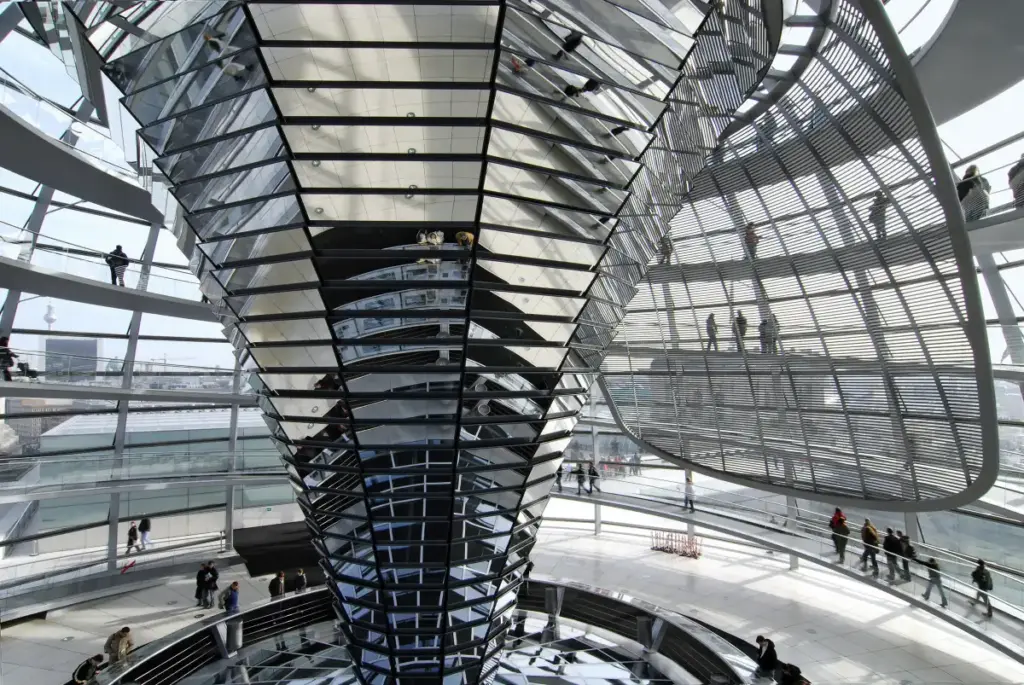
One of the most genius aspects of Foster’s design is the interior layout. To manage the millions of tourists who visit every year without creating crowd bottlenecks, Foster designed two intertwining spiral ramps.
- ⬆️ The Upward Ramp: One helix is dedicated entirely to visitors walking up.
- ⬇️ The Downward Ramp: The second helix is for walking down. This double-helix design ensures a smooth, continuous flow of foot traffic, much like a well-oiled machine.
🪜 The Roof Terrace
Before you even enter the glass cupola, you step out onto the expansive roof terrace. This space offers 360-degree views of Berlin and houses the famous Käfer Dachgarten, a high-end restaurant that serves both politicians and the public.
🕊️ Democratic Symbolism: Architecture with a Message
Norman Foster did not just build a pretty glass structure; he built a physical manifestation of democratic ideals. Every element of the dome tells a political story.
👁️ Transparency in Government
For decades, German politics were associated with secrecy, dark backrooms, and authoritarianism. The glass dome was designed to be the exact opposite. Glass represents transparency. It allows the public to look inside the building, symbolizing that the government has nothing to hide.
⬆️ The People Above the Politicians
This is the most powerful symbolic gesture of the entire building. The spiral walkways of the dome are positioned directly above the Plenary Chamber, where the elected politicians debate and vote. As you walk up the ramp, you can look down through the glass floor at the politicians working below. This architectural choice literally places the citizens above the government, reminding lawmakers that they serve the people. 🇩🇪
🪞 The Mirror Cone (Tageslichtspiegel)
Hanging directly in the center of the dome is a massive, inverted cone covered in 365 mirrors (one for every day of the year).
- What it does: The cone acts as a giant funnel, capturing natural sunlight and reflecting it directly down into the parliamentary chamber below.
- The Message: It brings the light of the outside world (the public) into the heart of political decision-making.
☀️ Eco-Engineering: A Sustainable Marvel
Beyond its looks, the Reichstag dome is a pioneer in green architecture. Foster designed the building to operate as an eco-friendly organism.
🌬️ Natural Ventilation (The Chimney Effect)
The cone in the center of the dome isn’t just for bringing light in; it also pushes stale air out. The dome acts as a massive exhaust vent. Fresh air is drawn into the parliament chamber, and the hot air rises and escapes through the top of the cone, drastically reducing the need for mechanical air conditioning.
🔆 Sun Tracking
The 365 mirrors on the cone are not static. They are computer-controlled and automatically rotate to follow the path of the sun across the sky, ensuring maximum natural light enters the chamber all day long.
- ☁️ On cloudy days: Special shutters open to let in ambient light.
- ☀️ On bright sunny days: The shutters close to prevent the politicians below from being blinded or overheated.
🎧 The Visitor Experience: What to Expect
If you are planning to visit, here is a walkthrough of what your experience will look like.
1. 🛂 Security & Arrival
Because it is a working government building, security is tight. You will pass through airport-style scanners. Remember to bring your original passport, as your name must match your booking exactly!
2. 🚀 The High-Speed Elevators
You won’t have to walk all the way up from the ground floor. Two massive, high-speed elevators will whisk you up to the roof terrace and the base of the dome in seconds.
3. 🎧 The Genius Audio Guide
Before you step onto the spiral ramps, you will be handed a free, handheld audio guide.
- How it works: The device uses location-triggering technology. As you walk around the dome, the audio guide automatically senses where you are standing and plays the corresponding commentary.
- What you’ll hear: It will explain the history of the building, the mechanics of the mirror cone, and point out famous Berlin landmarks as you pass them. It is available in over 20 languages!
4. 📸 The 360-Degree View
As you spiral your way to the top, you will get unobstructed views of:
- 🚪 The Brandenburg Gate
- 🗼 The Berlin TV Tower (Fernsehturm)
- 🌳 The vast greenery of the Tiergarten Park
- 🏢 The modern Potsdamer Platz skyline
💡 Practical Tips for Tourists Visiting the Dome
To ensure your visit goes smoothly, keep these essential tips in mind:
- 🎫 Booking is Mandatory (and Free): You cannot just walk in. You must register for a free time slot on the official Bundestag website well in advance.
- 🕒 Aim for Sunset: The most popular time to visit is right before sunset. You get to see Berlin in daylight, watch the sun go down, and see the city lights turn on. Book these slots months in advance!
- 🧥 Dress for the Weather: The roof terrace is outdoors and can be incredibly windy, even in summer. In winter, it is freezing. Bring a light jacket or a windbreaker.
- 🎒 Pack Light: Large backpacks, suitcases, and tripods are strictly prohibited. Bring only a small day bag and your camera.
- 👶 Family Friendly: The dome is fully wheelchair and stroller accessible thanks to the elevators and wide ramps.
❓ Frequently Asked Questions (FAQ)
Q: How long does a visit to the glass dome take? A: Plan for about 45 minutes to 1 hour. This includes going through security, taking the elevator, walking the spiral ramps at a leisurely pace, and taking photos.
Q: Can I take photos inside the dome? A: Yes! Personal photography is highly encouraged. However, professional filming equipment and tripods are not allowed without special press accreditation.
Q: Is the dome open at night? A: Yes! The dome is open late into the evening. Seeing the mirror cone illuminated from the inside while looking out at the dark city is a magical experience. 🌌
Q: What happens if it rains? A: The dome is fully enclosed with glass, so rain will not ruin your visit. However, on very stormy days, the outdoor roof terrace might be temporarily closed for safety.
🇩🇪 Final Thoughts
The Reichstag Glass Dome is a triumph of modern architecture. Norman Foster took a building burdened by a dark and heavy past and transformed it into a beacon of light, transparency, and hope.
When you stand on the spiral ramp, looking down at the heart of German democracy and out over the sprawling city of Berlin, you aren’t just looking at a tourist attraction. You are standing inside a promise—a promise of openness, unity, and a brighter future.
Don’t miss your chance to walk the spiral! ✨
(Safe travels, and enjoy your architectural adventure in Berlin!) 🎒📸
