
Reichstag Building: History, Architecture, and Visitor Tips
Introduction: A Symbol of German Democracy
When you think of the Berlin skyline, one structure stands out not just for its height, but for its profound historical weight: the 국회의사당 건물. Home to the German Bundestag (Federal Parliament), this architectural masterpiece is more than a government office; it is a physical timeline of Germany’s turbulent 20th century. From the Imperial Era to the Third Reich, through division and neglect, to its glorious rebirth as a symbol of reunification, the Reichstag tells the story of a nation.
For travelers, history buffs, and architecture enthusiasts, a visit to the Reichstag is non-negotiable. Whether you are walking the spiral ramp of the famous glass dome or standing beneath the inscription “Dem Deutschen Volke” (To the German People), the experience is moving.
In this comprehensive guide, we will delve deep into the Reichstag Building’s history, analyze its unique architecture, and provide a step-by-step visitor guide to ensure you secure your spot at Berlin’s most popular landmark.
1. The Turbulent History of the Reichstag
To understand the building, you must understand the timeline. The stones of the Reichstag have witnessed the birth of an empire, the collapse of democracy, the horrors of war, and the joy of unity.
The Imperial Era (1894–1918)
Commissioned by Kaiser Wilhelm I, the original building was designed by architect Paul Wallot. Construction began in 1884 and was completed a decade later in 1894. At the time, it was one of the largest and most impressive parliament buildings in the world, featuring a distinctive dome that was technically advanced for its era. However, the Kaiser held a grudge against the parliament and famously disliked the building, referring to it as a “monkey house” and refusing to enter it for years.
The Fire and the Third Reich (1933–1945)
The most infamous event in the building’s history occurred on February 27, 1933. A devastating fire broke out in the plenary hall. The Nazi regime, led by Adolf Hitler, used the fire as a pretext to suspend civil liberties and consolidate power, marking a pivotal step toward dictatorship. While the building was damaged, it remained structurally sound. During World War II, it suffered further damage from Allied bombing and the Battle of Berlin in 1945. Soviet soldiers famously graffitied the walls inside (some of which were preserved during renovation) and raised the Red Flag over the building, signaling the end of the war in Europe.
Cold War Neglect (1945–1990)
Following the war, Berlin was divided. The Reichstag sat in the British sector of West Berlin, but right on the border with East Berlin. Since the capital of West Germany was moved to Bonn, the building lost its political function. It stood as a hollow shell, a ghost of the past, occasionally used for exhibitions but largely ignored. The division of Germany was physically manifested by the Berlin Wall, which was constructed just meters from the Reichstag’s rear facade in 1961.
Reunification and Renovation (1990–Present)
With the fall of the Wall in 1989 and German reunification in 1990, Berlin was once again declared the capital. A decision was made to move the Parliament back to the Reichstag. A competition was held to redesign the interior, won by British architect Sir Norman Foster. His design respected the historical shell while injecting modern transparency and sustainability. In 1999, the Bundestag held its first session in the renovated building, marking the completion of Germany’s political return to Berlin.
2. Architecture: A Blend of Old and New
The Reichstag is a masterclass in adaptive reuse. The exterior retains the grandeur of the 19th-century neo-Renaissance style, while the interior is a futuristic vision of transparency.
Paul Wallot’s Original Design
The sandstone facade features intricate carvings, grand staircases, and imposing columns. One of the most significant features is the inscription on the front portico: “DEM DEUTSCHEN VOLKE” (To the German People). Interestingly, this inscription was added in 1916 during WWI. It was removed by the Nazis (who viewed the parliament as weak) and only restored during the 1990s renovation.
Norman Foster’s Modern Intervention
Foster’s philosophy was “transparency of government.” He wanted citizens to be able to look down upon their politicians, literally and metaphorically.
- The Plenary Hall: The debating chamber was moved from the center of the building to allow for the new dome structure. It is designed with light wood and modern acoustics.
- The Roof Garden: The flat sections of the roof are covered in vegetation, helping with insulation and rainwater management.
- Sustainability: The building is a pioneer in energy efficiency. It uses a combined heat and power plant and burns biofuel to generate electricity.
3. The Iconic Glass Dome (Kuppel)
The crown jewel of the Reichstag renovation is the Glass Dome. It is the primary reason most tourists visit the building.
Design and Function
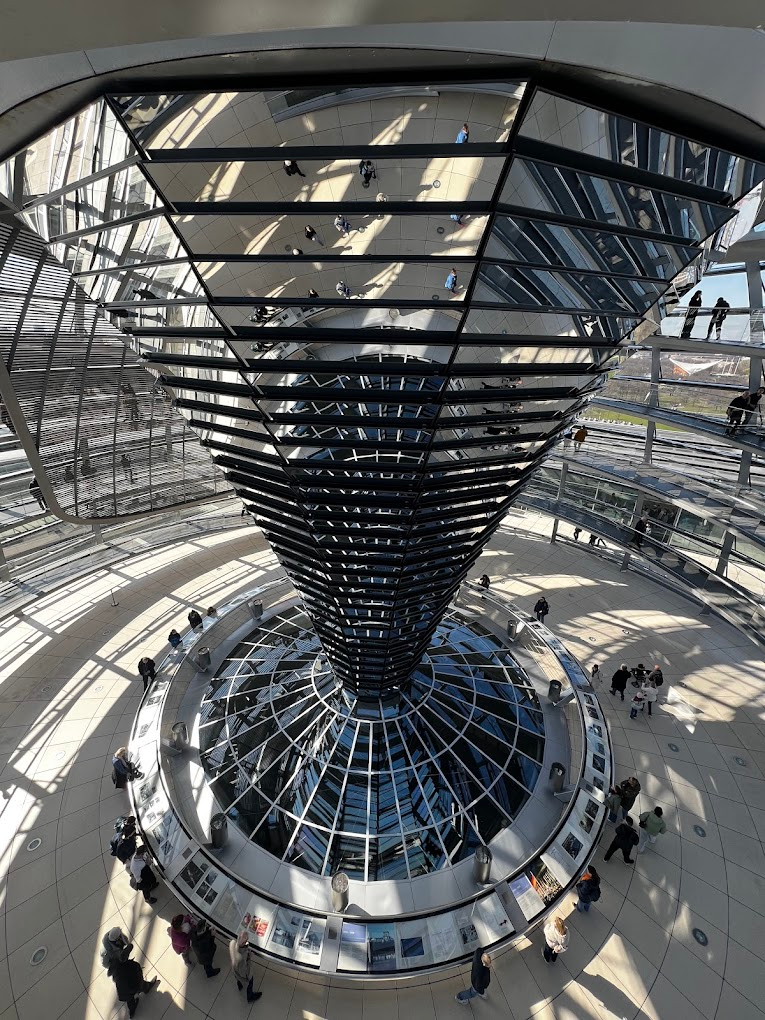
The dome is made of 3,000 panes of glass and steel. It is not merely decorative; it serves a functional purpose for the building’s climate control.
- The Mirror Cone: In the center of the dome hangs a massive, inverted cone covered in 360 mirrors. It reflects natural light down into the plenary hall below, reducing the need for artificial lighting during the day.
- Ventilation: The dome acts as a chimney. In summer, hot air rises and escapes through vents at the top, drawing fresh air through the building. In winter, the process is reversed to retain heat.
The Visitor Experience
Visitors access the dome via a spiral ramp. There are two ramps: one for ascending and one for descending.
- The Walk: As you spiral upward, you are treated to 360-degree panoramic views of Berlin.
- Key Landmarks: On a clear day, you can spot the Brandenburg Gate, the Tiergarten, the Berlin Cathedral, and the Potsdamer Platz.
- Audio Guide: As you walk, an automated audio guide (available in many languages) triggers based on your location, pointing out specific landmarks outside and explaining architectural features inside.
- The Platform: At the very top, there is a viewing platform where you can step outside the glass for an unobstructed view (weather permitting).
4. How to Visit the Reichstag Building: Essential Logistics
Visiting the Reichstag is free of charge, but it requires planning. Due to high security and massive demand, you cannot simply walk in.
Step 1: Registration is Mandatory
You must register your visit in advance. There are three ways to do this:
- Online: The most popular method. Register on the official Bundestag website. You can book up to two months in advance. Tip: Slots fill up quickly, especially for sunset times in summer.
- In Person: You can visit the Service Center near the Reichstag (Scheidemannstraße) up to two days before your visit. Expect long queues.
- Fax/Email: An older method, still available but slower.
Step 2: What You Need to Bring
- Photo ID: This is non-negotiable. You must bring the original physical ID or passport that you used during registration. A photocopy or photo on your phone will not be accepted. The name on the ID must match the registration exactly.
- Confirmation: Have your booking confirmation (printed or on your phone) ready.
Step 3: Security Check
Arrive at least 15 minutes before your scheduled time. You will go through an airport-style security screening. Bags are searched, and large luggage is not permitted. There are lockers available nearby if you are carrying backpacks.
Step 4: Opening Hours
- General Visits: Daily from 8:00 AM to midnight (last entry at 10:00 PM).
- Plenary Sessions: If the Parliament is in session, public access to certain areas may be restricted. Check the schedule online.
- Closure: The building is closed on days when the Bundestag is not sitting, usually during recess periods, but the dome generally remains open. Always check the official calendar.
Step 5: Dining Options
- Käfer Dachgarten Restaurant: Located on the roof terrace. It offers high-end German cuisine with a view. Reservations are essential and should be made well in advance. Dress code is smart casual.
- Cafeteria: There is a self-service cafeteria on the ground floor for a quicker, budget-friendly meal.
5. Top Tips for the Best Experience
To make the most of your trip, consider these insider tips:
- Go at Sunset: The view of Berlin bathed in golden hour light is spectacular. However, these are the most booked slots. Register exactly when the window opens (2 months prior) to secure this time.
- Visit on a Weekday Morning: If you want to avoid crowds inside the dome, aim for a Tuesday or Wednesday morning.
- Wear Comfortable Shoes: While the ramp is gentle, you will be standing and walking for at least 45 minutes to an hour.
- Combine with Nearby Sights: The Reichstag is in the Government Quarter (Regierungsviertel). After your visit, walk to the Chancellor’s Office (Bundeskanzleramt), stroll through the Tiergarten Park, or visit the Memorial to the Murdered Jews of Europe, which is a short 10-minute walk away.
- Look for the Graffiti: During the tour, keep an eye out for preserved Soviet graffiti from 1945 on the inner walls. It is a haunting reminder of the building’s past.
- Photography: Photography is allowed in the dome and most public areas. However, flash photography and tripods are generally discouraged in certain zones. Do not photograph security personnel.
6. Symbolism: Why the Reichstag Matters
The Reichstag is not just a tourist attraction; it is a statement.
Transparency
The glass dome symbolizes that the government should be transparent to the people. In the past, rulers hid behind stone walls; in modern Germany, the people look down on their representatives.
The Christo Wrapping
In 1995, before the renovation was complete, the artists Christo and Jeanne-Claude wrapped the entire building in silver fabric and blue rope. It was one of the most famous art installations of the 20th century. It signaled a “new beginning” for the building, hiding its scarred past to prepare for its future.
Democracy Restored
The return of the Parliament to Berlin was a psychological milestone. It signaled that Germany was no longer divided, that Berlin was whole, and that democracy had taken root firmly on the same soil where it had once failed.
7. Frequently Asked Questions (FAQ)
Q: Is visiting the Reichstag Building free? A: Yes, admission to the Reichstag, including the dome and the audio guide, is completely free. You only pay if you choose to eat at the rooftop restaurant.
Q: Do I need to book in advance? A: Yes. Walk-ins are rarely accepted. You must register online or in person at the service center. We strongly recommend online booking 2-4 weeks in advance.
Q: Can I take my camera inside? A: Yes, handheld cameras and smartphones are allowed. Selfie sticks and tripods are prohibited for security and crowd flow reasons.
Q: Is the Reichstag accessible for wheelchair users? A: Yes, the building is fully accessible. There are elevators available to access the dome for those who cannot use the spiral ramp. Please inform security upon arrival.
Q: What is the difference between the Reichstag and the Bundestag? A: The Reichstag is the name of the historic building. The Bundestag is the name of the German Federal Parliament that meets inside the building.
Q: How long does the visit take? A: Plan for at least 1 to 1.5 hours. This includes security, the audio guide walk through the dome, and time to enjoy the view.
Q: What happens if it is cloudy or raining? A: The dome visit operates in all weather conditions. The glass provides shelter, though the top outdoor platform may close during severe storms.
8. Surrounding Attractions: The Government Quarter
Your visit to the Reichstag can easily be the anchor of a half-day tour of Berlin’s political heart.
- The Chancellor’s Office (Bundeskanzleramt): Often jokingly referred to as the “Wash Machine” due to its modern design, it is the largest head of government office in the world. You can view it from the outside along the Spree river.
- The Tiergarten: Berlin’s central park is right behind the Reichstag. It is perfect for a picnic after your visit. Look for the Victory Column (Siegessäule) in the distance.
- House of World Cultures: A short walk away, this venue hosts exhibitions on non-European cultures and is known for its distinctive “pregnant oyster” roof architecture.
- Spree River Walk: Follow the river from the Reichstag towards Museum Island. It’s a scenic route that passes by the Humboldt Forum and the Berlin Cathedral.
Conclusion: A Must-See Landmark
The 국회의사당 건물 is a testament to resilience. It has survived fire, war, division, and neglect to emerge as one of the most modern and symbolic parliament buildings in the world. For the traveler, it offers a unique combination of breathtaking views, architectural genius, and deep historical context.
Whether you are standing atop the glass dome watching the sun set over the Brandenburg Gate, or reading the preserved graffiti of Soviet soldiers, the Reichstag connects you to the heartbeat of Berlin.
Remember: Plan ahead, bring your ID, and take a moment to reflect on the journey of democracy that this building represents. It is not just a stop on your itinerary; it is a lesson in history written in stone and glass.